Food Hygiene Level 2 for yacht crew is one of the certificates every stewardess and anyone handling food on a yacht must have before their first contract. It is mandatory, it is quick to get, and there is no route around it. This guide covers everything you need to know — what the certificate is, what MCA approved means, who needs it, what the course covers, and how to get certified. If you are ready to get started, visit our Food Hygiene Level 2 course page. For the full list of everything you need before joining your first yacht, read our qualifications checklist for yacht crew. If you are figuring out how to become a stewardess, start with our complete stewardess guide.

What Is Food Hygiene Level 2?
Food Hygiene Level 2 — formally the Level 2 Award in Food Safety and Hygiene — is an internationally recognised qualification for anyone who prepares, handles, or serves food professionally. On a superyacht, that covers stewardesses, chefs, galley assistants, and any crew member involved in food service for guests or crew.
The certificate is CPD accredited (Continuing Professional Development) and complies with European Union Regulation (EC) No 852/2004 on food hygiene. It is valid for three years from the date of issue. The course is completed entirely online and the certificate is issued digitally on the day you pass — you do not wait for it in the post.
The course is built around six practical modules that take you from the principles of food safety through to HACCP implementation, contamination control, and personal hygiene standards. It takes three to four hours to complete at your own pace with no scheduled start dates. At the end there is a 15-question multiple choice assessment — score 80% or above and the certificate is issued immediately.
What Does MCA Approved Food Hygiene Mean?
When you see “MCA approved food hygiene” or “MCA approved Food Hygiene Level 2”, it refers to the standard set by the UK Maritime and Coastguard Agency. The MCA is the UK authority responsible for setting and enforcing safety standards on commercial vessels flying the British Red Ensign flag. For UK-flagged yachts, the MCA requires all food handlers on board to hold a recognised food hygiene qualification — the Level 2 Award in Food Safety and Hygiene is the accepted standard for meeting that requirement.
It is worth understanding what MCA approved actually means in the context of yachting:
- It is technically a UK flag state requirement. The MCA sets this standard for yachts registered under the UK flag. Yachts flying Cayman Islands, Marshall Islands, Maltese, or other flags fall under those flag states’ own food safety requirements rather than the MCA’s directly.
- In practice it has become the global industry standard. The Level 2 Award in Food Safety and Hygiene is now expected on all commercial yachts worldwide regardless of flag state. Captains and management companies across the industry use MCA approved food hygiene as their benchmark because it is the clearest, most widely understood standard.
- Your certificate will be accepted everywhere. Whether the yacht is Cayman registered, Marshall Islands flagged, or flies the Red Ensign, a CPD-accredited Food Hygiene Level 2 certificate will be accepted without question. It has become the industry baseline, not a UK-only requirement.
When a Captain or Chief Stewardess asks if you have your food hygiene certificate, they are asking for the Level 2 Award — MCA approved is how they describe it because that is the language the industry uses. Get it once, carry it everywhere.
Is Food Hygiene Level 2 Mandatory for Yacht Crew?
Yes, for anyone who handles food on board. Food Hygiene Level 2 for yacht crew – The Maritime Labour Convention (MLC) sets out food safety requirements for commercial yachts, and Food Hygiene Level 2 is the accepted standard for demonstrating compliance. On charter yachts — commercial vessels carrying paying guests — this is actively checked during port state control inspections. A Captain cannot have uncertified food handlers on board without creating a compliance issue for the vessel.
The requirement applies to:
- All stewardesses — including third stewardesses and junior interior crew who assist in food service or provisioning
- Yacht chefs and sous chefs — mandatory, no exceptions
- Galley assistants — anyone who handles raw food in the galley
- Chief stewardesses — who manage provisioning, storage, and food service standards across the vessel
- Any crew member who handles, prepares, or serves food on a commercial yacht in any capacity
Even for deck crew, having the certificate on your CV signals that you are thorough about your qualifications — and on smaller yachts where departments overlap, it is increasingly expected of everyone on board.
What Does the Course Cover?
The six modules are designed to give you a complete working knowledge of food safety as it applies to a professional catering environment — which on a superyacht means a high-standard galley serving guests who expect five-star food at sea.
Module 1 — Food Safety Principles and Legal Obligations
An introduction to why food hygiene legislation exists, what the legal framework requires, and what your personal responsibilities are as a food handler on board. Covers EU Regulation EC No 852/2004 and what MLC compliance means in practical terms for yacht crew.
Module 2 — Microorganisms and Food Poisoning
How bacteria, viruses, moulds, and other microorganisms cause food spoilage and food-borne illness. The conditions they need to multiply, how contamination spreads in a galley environment, and what the consequences of food poisoning on board a yacht can mean for crew, guests, and the vessel’s reputation.
Module 3 — HACCP
Hazard Analysis and Critical Control Points — the internationally recognised food safety management system. This module covers how to identify critical control points in food preparation and service, how to monitor them, and how to document your approach in line with MLC and flag state requirements. HACCP is the framework that professional yachts use to demonstrate food safety compliance during inspections.
Module 4 — Contamination Hazards and Controls
The different types of contamination — physical, chemical, biological, and allergenic — how each occurs in a galley setting, and how to prevent cross-contamination between ingredients, surfaces, and equipment. Allergen management is increasingly important on charter yachts where guest dietary requirements must be taken seriously.
Module 5 — Cleaning and Disinfection
Correct cleaning and disinfection procedures for a galley environment. The difference between cleaning and disinfecting, which products to use on which surfaces, and how to maintain hygiene standards in a confined working space at sea where conditions are not always ideal.
Module 6 — Personal Hygiene and Temperature Control
The personal hygiene standards expected of all food handlers — handwashing procedures, protective clothing, illness reporting — and the principles of temperature control for safe food storage, chilling, defrosting, and cooking on board.
How Long Does It Take?
Three to four hours online at your own pace. You can complete it in a single sitting or spread it over a couple of days. No scheduled start dates, no classroom, no travel. You begin when you are ready and work through the modules on any device.

What Certificate Do You Receive?
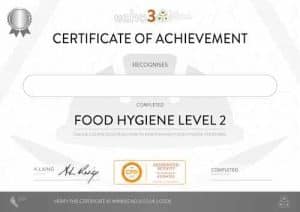
Upon passing the 15-question assessment with 80% or above, you receive a CPD-accredited Level 2 Award in Food Safety and Hygiene certificate. It is MCA approved, internationally accepted, and valid for three years. When it expires you complete a short refresher course rather than the full programme again. The certificate is issued digitally on the same day you pass — download it, save a copy, and add it to your CV immediately.
Food Hygiene on Charter Yachts
Food hygiene is not just a compliance checkbox on charter yachts — it is part of the service. Charter guests are paying significant amounts per week for a private yacht experience, and the standard of food preparation and presentation is one of the things they remember most. A single incident of food poisoning on a charter week does not just end the trip — it ends careers and damages the yacht’s reputation in a market where word travels fast.
Chief Stewardesses on charter yachts are responsible for provisioning for the entire charter, managing dietary requirements and allergies for each guest, and maintaining food hygiene standards across every meal service. They are also responsible for ensuring their interior team holds the correct certifications. If a port state inspector comes on board and a stewardess cannot produce a food hygiene certificate, it is a compliance failure for the vessel — not just an administrative oversight.
The certificate is the minimum. What actually makes a stewardess valuable in a charter environment is understanding why the standards exist and applying them consistently under the pressure of back-to-back charter weeks.
When Should You Get It?
Before your first contract — not after you get the job offer. Captains and Chief Stewardesses shortlisting applications expect to see it on your CV alongside your STCW Basic Safety certificate and your seafarer medical certificate. Showing up to an interview as a stewardess applicant without it is a red flag that suggests you have not done your research properly. It takes a few hours and costs very little. There is no reason to leave it until later.
If you train with Yachtiecareers, Food Hygiene Level 2 is included in every training package. You complete it during your training week in Split alongside your STCW, medical certificate, PDSD, Security Awareness, and your CV — nothing left over to organise separately when you get home.
Get Your Food Hygiene Level 2 Certificate
To enrol in the course and see exactly what is included, visit our Food Hygiene Level 2 course page. To view the full training packages that include Food Hygiene as part of your complete certification, see our stewardess training packages or deckhand training packages. For the complete list of certifications you need before your first contract, read our qualifications checklist for yacht crew.
If you want to talk through your situation and which package fits, book a free call with our team. You can also read what our students say on our reviews page.